

http://londonist.com/2014/05/watch-london-evolve-in-this-animation.php
Month: July 2014
Charles the Fat and the Viking Great Army : The Military Explanation for the End of the Carolingian Empire By Simon MacLean
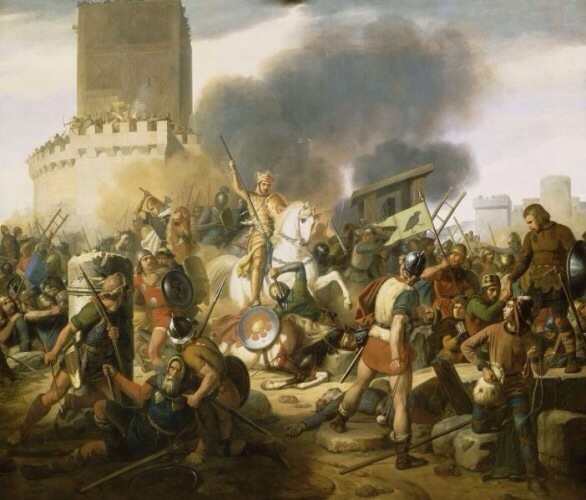
Introduction: In late July 885 a large Viking fleet gathered at the mouth of the River Seine and began to move upstream in the direction of Paris. After overcoming resistance at Rouen and Pontoise, in November the invaders stopped before the towers and bridges of Paris and, having been refused free passage by the inhabitants, dug in to lay siege to the town. Archbishop Fulk of Rheims, alarmed at the situation, sent an anxious letter across the Rhine to the king and emperor of the Franks Charles III (known today as ‘the Fat’) urging him to take action. The letter recalled the sterling job of defence which had been done by Charles’ predecessors in the west Frankish kingdom (he himself had assumed control in this part of the empire only in May) and pointed out the whole empire was in his custody.
Furthermore, Fulk ‘reminded him that the city of Paris, which defends the chief palace and entrance to the lands of Neustria and Burgundy, was surrounded by a barbarian siege, and would quickly fall unless it was relieved by the mercy of God; if it was captured, it would be at the cost of the suffering of the whole kingdom.
Consciousness
Experimenting with English (Part 2) – Activities for learners to do outside the classroom [26 and counting!]

In my blog post Experimenting with English: scaffolding learner autonomy, I discussed how I approached helping my learners to use English outside the classroom, drawing on learner autonomy theory and methodology (e.g. Benson, 2011; Oxford, 2003; Smith 2003). Central to that project, alongside the very important element of discussion, was a handout I created for my learners.
Here is a screenshot of a sample page, taken from the listening section:
 Sample page from my Experimenting with English activities handout, listening section.
As you can see, the handout consists of a series of activities for learners to try, with space for them to record when they tried it and what they thought of it. The handout is divided up by skill (reading, listening, speaking, writing). What you can’t see here is that in each subdivision, as well as the activities I’ve added, there is space for the learners…
View original post 587 more words
Welcome

Welcome to my new blog Traveling Grain. I will post articles about my upcoming blending trip to Europe.
Much grace to all my readers.
 Contemplations