St Govan’s chapel Pembrokeshire

pilgrimagemedievalireland's avatarPilgrimage In Medieval Ireland

A few weeks ago I had a fantastic holiday exploring parts of  Wales  and England. One of the  most amazing places I visited  was a tiny medieval chapel called St Govan’s chapel in Pembrokshire, Wales.

1-Trip wales Galaxy S5 452 St Govan’s Chapel Pembrokeshire Wales

St Govan’s chapel is located at the base of a cliff, a short distance from the village of Bosherston. The site  has an Irish connection as   Govan is  supposedly an Irish saint.

1-Trip wales Galaxy S5 410 Cliff top above St Govan’s church

The present chapel dates to c.  the 13th century and it may have been built on an earlier structure.  The chapel can be accessed from  the top of the cliff by climbing down a series of steep steps.

1-Trip wales Galaxy S5 413 Steps leading to St Govan’s chapel

The church is a small single single cell room built into a rock cleft  and it has  a vaulted ceiling.

1-Trip wales Galaxy S5 430 West wall of chapel

A stone altar  is…

View original post 309 more words

Multilingual Mirrors Part 2

Nick Zair's avatarGreek in Italy

Katherine wasn’t the only person thinking about Etruscan around Christmas (see her post below). On Boxing Day I went to the Museo Nazionale Etrusco di Villa Giulia in Rome to see their fantastic collection of Etruscan finds. They’ve got some spectacular stuff including the sarcophagus of the spouses (of which there’s a picture in Katherine’s post), and three gold tablets from Pyrgi which are written in Etruscan and Punic (pictured below). In real life they’re surprisingly small, but just as golden as they look here (Etruscan on the right and left, Punic in the middle). It’s thanks to these tablets – which aren’t direct translations of each other, but contain similar material – that we know the Etruscan word for ‘three’, which is ci. The museum has a particularly good section on writing and the alphabet.

From http://en.wikipedia.org/wiki/File:EtruscanLanguage2.JPG

What, you may be asking, does all this have to do with mirrors?…

View original post 227 more words

Alexander’s Battle in India

9minnon's avatar9minnon's Blog

Some would say that the title of this post should be “Alexander’s Battle in Pakistan”, but at that time Pakistan didnt exist, and probably thats why historians and these guys (no I am not confusing the two, being poles apart) refer to this battle in India. This is the battle that Alexander, having defeated all the empires on the way from Macedonia, including the mighty Darius, fought as he reached the Indian subcontinent. This was the battle he fought against the King Porus (known as Porus to the Greeks, the traditional name being King Purushottam), the king of Paurava. Paurava was the ancient Indian kingdom between the Jhelum and Chenab rivers. Some historians believe that this was a part of the larger Magadha kingdom, but thats a separate debate.

These guys were discussing about this, and this was a sort of continuation of this post. To cut a long…

View original post 383 more words

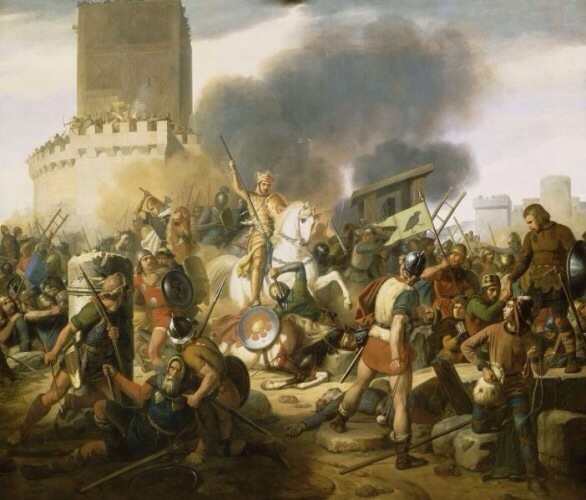
Charles the Fat and the Viking Great Army : The Military Explanation for the End of the Carolingian Empire By Simon MacLean

Introduction: In late July 885 a large Viking fleet gathered at the mouth of the River Seine and began to move upstream in the direction of Paris. After overcoming resistance at Rouen and Pontoise, in November the invaders stopped before the towers and bridges of Paris and, having been refused free passage by the inhabitants, dug in to lay siege to the town. Archbishop Fulk of Rheims, alarmed at the situation, sent an anxious letter across the Rhine to the king and emperor of the Franks Charles III (known today as ‘the Fat’) urging him to take action. The letter recalled the sterling job of defence which had been done by Charles’ predecessors in the west Frankish kingdom (he himself had assumed control in this part of the empire only in May) and pointed out the whole empire was in his custody.

Furthermore, Fulk ‘reminded him that the city of Paris, which defends the chief palace and entrance to the lands of Neustria and Burgundy, was surrounded by a barbarian siege, and would quickly fall unless it was relieved by the mercy of God; if it was captured, it would be at the cost of the suffering of the whole kingdom.

20140703-221449-80089477.jpg